
Root Canal Treatment in Sushant Lok, Gurugram
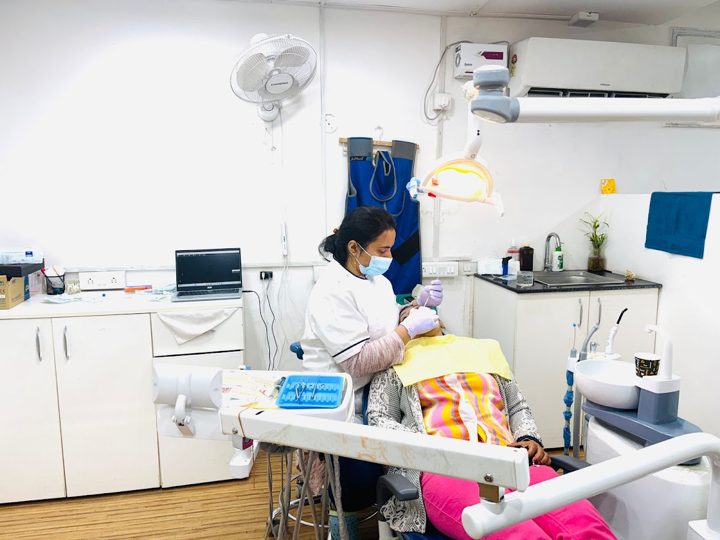
A root canal saves a tooth whose nerve has become infected or inflamed, instead of taking it out. The infected tissue inside the tooth is removed, the canals are cleaned and sealed, and the tooth is usually protected with a crown afterwards. At Modenta Dental Clinic in Sushant Lok Phase 1, Sector 43, Gurugram, the canals are also disinfected with a dental laser, led by Dr Aarti Trakroo, who holds a diploma in laser dentistry from SOLA, Vienna.
Book on WhatsAppCall +91 78376 74763
What a root canal is
Inside every tooth is a soft core of nerve and blood vessels, the pulp. Deep decay, a crack or an old large filling can let bacteria reach it. Once the pulp is infected it cannot heal on its own, and the infection can spread to the bone at the tip of the root. A root canal removes that pulp, disinfects the canals and seals them so the tooth can stay in your mouth and keep working.
Signs you may need one
- Toothache that lingers after hot or cold, or wakes you at night
- Pain when biting down on one tooth
- A swelling or a small pimple on the gum near a tooth
- A tooth that has darkened after an injury
Some infected teeth cause no pain and are found on an X-ray. Equally, not every toothache needs a root canal: decay caught early can often be treated with a filling, which is why the examination comes first.
Who it suits, and the alternatives
A root canal suits a tooth that is worth saving, with enough sound tooth left to restore and healthy bone around it. Keeping your own tooth is usually the better long-term choice. The alternative is an extraction, followed by an implant, a bridge or a denture to fill the gap. If a tooth cannot be saved, you are told so plainly.
What happens, visit by visit
- Examination and X-ray. The tooth is checked and X-rayed to see the roots and how far the infection has spread.
- Cleaning the canals. Under local anaesthetic, the infected pulp is removed and the canals are shaped, then disinfected with the laser, which reaches fine branches that instruments cannot.
- Sealing. The canals are filled and sealed. Some teeth are finished in one sitting; infected or complex teeth may need a second visit.
- The crown. Back teeth in particular are protected with a crown, because a root-treated tooth is more brittle than before.
Recovery and aftercare
Some tenderness for a few days is normal, especially when chewing on that side, and it usually settles with simple painkillers. Avoid biting hard on the tooth until the crown is fitted, keep brushing and flossing as usual, and keep the follow-up visit. Call the clinic if swelling increases or the pain gets worse rather than better after the first few days.
Who treats you

BDS, MDS (Prosthodontics & Implantology) · Prosthodontist & Implantologist
Trained in advanced implantology at Kyushu Dental College, Japan; plans implants, crowns, bridges, dentures and full-mouth work.

BDS, MDS (Oral Medicine & Radiology) · Oral Medicine & Radiology specialist, laser dentistry
12 years in practice, with a diploma in laser dentistry from SOLA, Vienna; leads laser root canals and laser gum care.
Guides on root canal treatment
Questions before you book?
Modenta Dental Clinic · 2772, C Block, Sushant Lok Phase 1, Sector 43, Gurugram
Frequently asked questions
Is a root canal painful?
It is done under local anaesthetic, so most people feel pressure rather than pain, much like a filling. The aching tooth often feels better once the infected nerve is removed.
What does the laser add?
After the canals are cleaned and shaped, the laser disinfects them, reaching the fine branches that hand instruments cannot. Patients often say the treatment was more comfortable than they expected.
How many visits does it take?
Often one or two. A straightforward tooth can be finished in one sitting; a badly infected or curved tooth may need a second visit before it is sealed.
Do I need a crown afterwards?
Usually, for back teeth. A root-treated tooth is more brittle, and a crown protects it from cracking under chewing.
